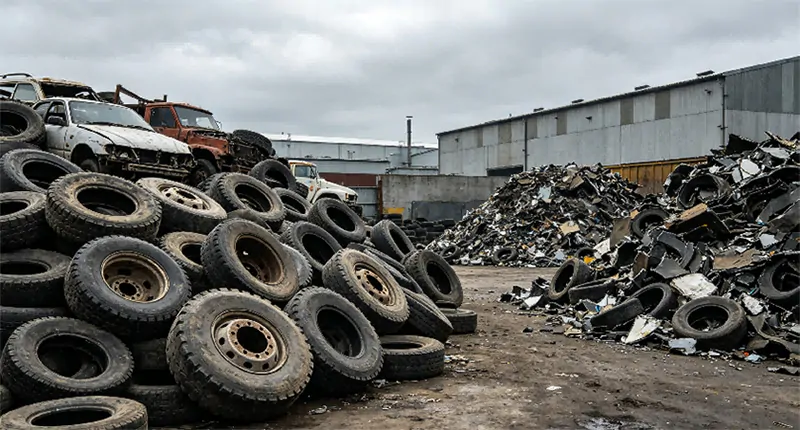
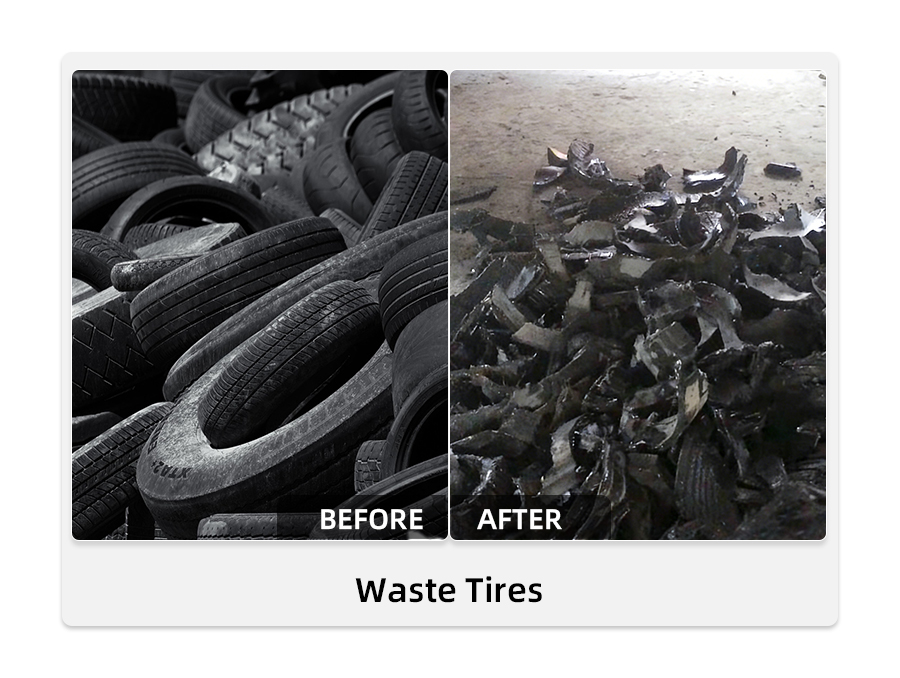
Scrap tires are generated every day from cars, trucks, and industrial vehicles, and disposing of them as whole tires is increasingly costly and restricted.
This article explains how to shred tires safely and efficiently, from collection to final output, and what equipment is needed for a reliable tire shredding operation.
2. Why Shred Tires & What You Can Get From Shredded Tires
Shredding tires is one of the most practical ways for you to handle growing volumes of scrap tires. Whole tires take up significant space, are expensive to transport, and are increasingly restricted from landfills.
By reducing tires into smaller pieces, you can lower storage and logistics costs while making the material much easier to manage in downstream processes. More importantly, once shredded, tires are no longer just waste, they become a source of reusable materials that you can sell into different markets.
Rubber is your main output and can be processed into mulch, chips, granules, or fine powder depending on your equipment setup. These materials are widely used in landscaping, sports surfaces, and rubber-modified asphalt.
If your target market does not require fine processing, you can produce coarse tire chips for tire-derived fuel (TDF), which is commonly used by cement plants and other industrial users.
During shredding and separation, you can also recover steel wire. This steel can be sold as scrap, giving you an additional revenue stream.
Fiber is another by-product. While its value is lower, proper separation still helps you improve the overall quality and marketability of your rubber output.
In practice, shredding allows you to turn a difficult waste stream into multiple usable products, giving you more flexibility in how you run and profit from your recycling operation.
3. How to Shred Tires: Step-by-Step Process
3.1 Tire Collection and Sorting
The process starts long before the machine is turned on. Tires need to be collected, transported, and sorted to ensure a stable and safe feeding process.
At this stage, operators typically remove steel rims and check for large foreign objects such as rocks, tools, or excessive mud. These materials can damage shredder blades or cause unexpected downtime.
Proper sorting also helps maintain consistent output quality, especially when processing different types of tires like passenger, truck, or OTR tires.
3.2 Pre-Shredding Whole Tires
Once prepared, whole tires are fed into a primary shredder, usually a double shaft shredder designed for high torque and low speed operation.
This machine cuts the tires into rough chips, typically under 100 mm (around 4 inches), depending on the screen size and blade configuration.
Pre-shredding plays a critical role in reducing volume and making the material easier to handle. It also prepares the tires for further processing, especially for lines that require granulation.
3.3 Steel Separation
After the initial shredding stage, the material contains a mix of rubber, steel wire, and fiber. Magnetic separators are used to extract the steel wire from the shredded rubber. This step not only improves the purity of the rubber but also protects downstream equipment from metal damage.
Efficient steel removal is essential, especially if the next step involves granulators or fine grinding systems.
The recovered steel can then be collected and sold as scrap, adding to the overall profitability of the recycling process.
3.4 Granulation
If the goal is to produce rubber granules or powder, the pre-shredded material is sent into a granulator.
Tyre Granulators operate at higher speeds and are designed to reduce rubber chips into much smaller and more uniform sizes. Depending on the setup, output can range from a few millimeters down to fine crumb rubber.
This stage is where the value of the material increases significantly. Smaller and cleaner rubber particles are in higher demand for applications such as rubber flooring, artificial turf infill, and modified asphalt.
3.5 Screening and Sizing
After granulation, the material is passed through a screening system to separate it into different size fractions.
Oversized material is usually returned to the granulator for further processing, while correctly sized particles move forward as final product.
Consistent sizing is key for meeting customer requirements. Different markets often demand specific particle sizes, so accurate screening directly affects product value.
3.6 Final Material Collection and Storage
At the final stage, rubber granules, powder, steel wire, and fiber are collected separately. Each material stream should be stored properly to maintain quality. Rubber products are best kept in dry, clean conditions to prevent moisture buildup and contamination.
Organized storage also makes it easier to handle logistics, whether the material is being transported, sold, or further processed.
A well-managed output system not only improves product quality but also helps streamline the entire recycling operation.
4. Key Safety Points and Common Mistakes
Running a tire shredding plant safely is just as important as maintaining output. If you overload the shredder, it can quickly lead to jams, higher motor stress, and uneven cutting performance, especially when feeding is not consistent.
Regular blade inspection also plays a key role in keeping your system efficient. Worn cutters will reduce output quality and increase energy consumption, and without proper training, operators may develop poor feeding habits that cause unnecessary downtime.
You should always make sure operators wear proper PPE, including safety glasses, gloves, hearing protection, and dust masks, since tire shredding involves noise, dust, and flying debris. With trained staff and consistent operating practices, you can keep your system running more safely and reliably.
5. Choosing the Right Tire Shredding Equipment
5.1 Double Shaft Tire Recycling Shredder
The Double Shaft Tire Recycling Shredder is usually the first and most important machine in the line. It is designed to handle whole tires directly, using low speed and high torque to break them down into smaller, manageable pieces.
This type of shredder is well-suited for producing tire chips used in rubber mulch or tire-derived fuel (TDF). It runs steadily, handles tough materials, and is less sensitive to occasional contaminants compared to high-speed machines.
5.2 Steel Separator, Granulator, and Screening System
For operations targeting finer rubber products, additional equipment is needed after shredding. A Steel Wire Separator removes most of the wire, helping protect downstream machines and improve product purity.
The granulator then reduces the material further into smaller, more uniform sizes, while the screening system ensures consistent output by separating different size fractions.
In a complete tire recycling plant, these machines work together to produce clean, size-controlled rubber granules or powder. Choosing the right combination depends on your target product, required output size, and overall capacity.
FAQs
Q: Is it safe to shred tires at a small scale?
A: Yes, as long as you use the right shredder, follow safety rules, and train operators properly.
Q: How many tons of tires can a typical tire shredder process per hour?
A: Most industrial tire shredders handle 1–15 tons per hour, depending on tire type and output size. Smaller shredders may process 0.8–3 t/h, while larger double-shaft models can reach 5–15 t/h.
Q: What’s the difference between a tire shredder and a tire granulator?
A: A tire shredder cuts whole tires into larger chips, while a granulator reduces those chips into smaller granules or powder. Shredders are for pre-shredding, granulators are for fine recycling.
Q: Do I need a full recycling line or just a shredder?
A: If you only need coarse shredded tires for TDF or mulch, a shredder plus steel separator may be enough. For fine rubber powder, you’ll need granulation and screening.
Q: How do I shred tires without damaging the shredder?
A: Remove rims and large foreign objects, feed tires steadily without overloading, and inspect blades regularly. Avoid feeding tires with too much dirt, mud, or metal debris.
Final Thoughts
Shredding tires is not just about cutting them up, it’s about doing it safely, efficiently, and in a way that turns waste into a sellable product. When you choose the right shredder and process, you can improve efficiency, recover more usable output, and build a more profitable tire recycling operation. With ENERPAT, you get a reliable tire shredding solution designed to help you turn waste tires into valuable resources.
Enerpat is a global company specializing in waste-recycling and disposal solutions, with a mission to help customers build a better, more sustainable world. We are a leading global provider for municipal and industrial clients, helping them recycle and dispose of waste, reduce costs and consumption, and create more value.
We focus on sorters, shredders, balers, shears, and disposal equipment for a wide range of recycling needs. Enerpat believes that “Quality Transform The World.” We deliver the industry’s highest levels of quality and service. Choosing Enerpat means choosing trust and value.
 English