In June 2026, the ENERPAT team conducted a pre-sales technical consultation at a large appliance recycling and logistics facility in Baltimore, Maryland. The visit was led by ENERPAT's COO, focusing on evaluating the customer's refrigerator and washing machine recycling operation, understanding current transportation costs, and recommending a more efficient metal baling solution to reduce logistics expenses and improve scrap value.
Customer Background
The customer is a privately owned logistics and transportation company serving industrial manufacturing, construction, and recycling businesses across the eastern United States. In addition to transportation services, the company operates multiple appliance recycling facilities where used refrigerators, washing machines, water heaters, and other household appliances are collected, sorted, and processed.
The customer currently operates four recycling locations across:
Baltimore
New York
New Jersey
Pennsylvania
Usable appliances are exported to overseas second-hand markets, while non-repairable units are sold as scrap metal after dismantling.
The current processing capacity is approximately 300 appliances per day, with a handling rate of around 50 units per hour.
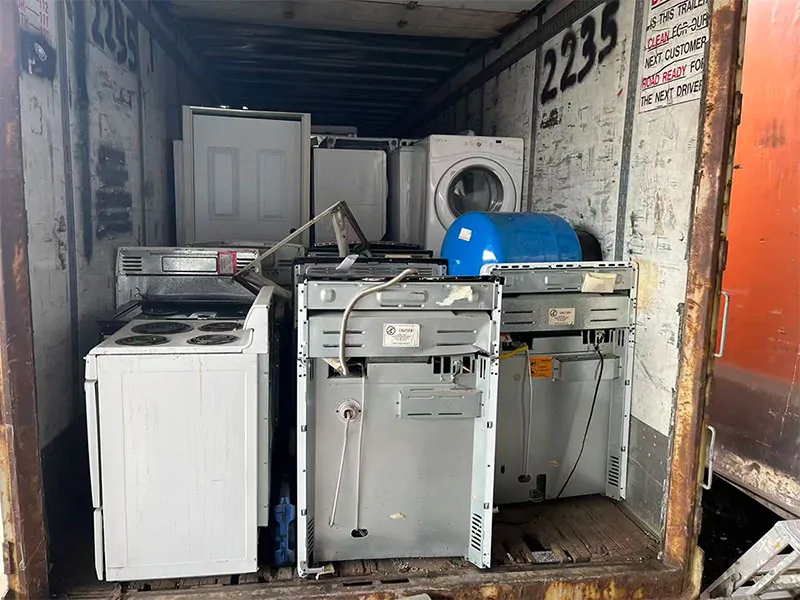
Although the existing equipment supports part of their recycling business, bulky scrap appliances still occupy significant trailer space during transportation.
Customer Challenges
During the factory tour, the customer explained that discarded refrigerators and washing machines are currently loaded directly onto trucks and transported to nearby metal recycling facilities.
Because of their large volume, each truck can only carry approximately 6–7 tons of appliances, resulting in high transportation costs that significantly reduce profit margins.
The customer was therefore looking for a way to:
Reduce transportation costs
Increase payload per truck
Improve storage efficiency
Deliver denser scrap packages to downstream recyclers
Processing rate: approximately 50 appliances per hour
One baling cycle (including loading): approximately 3 minutes
Estimated output: around 20 bales per hour
Each bale can contain 2–3 refrigerators or washing machines
The proposed solution is capable of meeting the customer's current production requirements while substantially reducing transportation volume.
The customer was also informed that an identical machine would soon be available at ENERPAT's Ohio warehouse for live material testing. Once prepared, the customer plans to bring their own scrap appliances for on-site verification before making a purchasing decision.
What is the ENERPAT Lid Style Scrap Metal Baler?
The ENERPAT Lid Style Scrap Metal Baler is engineered to efficiently compress large, lightweight scrap into compact, high-density bales that are easier to store, transport, and recycle. Designed for demanding recycling operations, it is particularly effective for processing bulky metal items such as refrigerators, washing machines, water heaters, steel cabinets, sheet metal, and mixed household appliances.
Using a powerful hydraulic compression system, the machine reduces the volume of scrap without requiring extensive pre-processing, helping recyclers maximize truck loading capacity and lower transportation costs. For businesses handling end-of-life appliances, the baler transforms oversized waste into valuable, furnace-ready scrap while improving yard organization and overall operational efficiency. Available in multiple configurations, the ENERPAT Lid Style Scrap Metal Baler can be tailored to suit different material types, production capacities, and recycling applications, making it a reliable solution for appliance recyclers, scrap processors, and metal recovery facilities worldwide.
Next Steps
To further validate the application, ENERPAT will:
Conduct internal baling tests using scrap refrigerators and washing machines
Record processing videos and production data
Share performance results with the customer
Invite the customer to the Ohio warehouse for live demonstrations
These tests will provide both parties with reliable production data and increase confidence before equipment investment.
Customer Feedback
The customer showed strong interest in replacing manual transportation with on-site metal baling to improve logistics efficiency.
They also indicated plans to sell their unused two shaft shredder and prioritize investment in a dedicated scrap metal baler for appliance recycling.
The visit further strengthened communication between both teams and established a clear roadmap for future cooperation.
Enerpat is a global company specializing in waste-recycling and disposal solutions, with a mission to help customers build a better, more sustainable world. We are a leading global provider for municipal and industrial clients, helping them recycle and dispose of waste, reduce costs and consumption, and create more value.
We focus on sorters, shredders, balers, shears, and disposal equipment for a wide range of recycling needs. Enerpat believes that “Quality Transform The World.” We deliver the industry’s highest levels of quality and service. Choosing Enerpat means choosing trust and value.
 English