You are here:ENERPAT Home » News » Company News » Melbourne, Australia: ENERPAT AMB-H2014-250 Metal Scrap Baler & MSB-E1200 Dual Shaft Shredder Installed
A Two-Stage Recycling Solution for Rejected Power Tools
For businesses handling professional power tools, products that fail inspection or can no longer be sold present a challenge beyond inventory management. They must be removed from the sales stream, processed according to the business's handling requirements, and prepared for an appropriate downstream recycling route.
In Melbourne, Australia, an industrial tool distribution business selected ENERPAT equipment to improve the handling of rejected power tools. The project combines an MSB-E1200 Dual Shaft Shredder with an AMB-H2014-250 Metal Scrap Baler, bringing size reduction and metal compaction into one coordinated workflow.
The reason for using two machines is practical. Whole power tools are bulky and contain a mixture of materials. Feeding them directly into a metal baler is not an ideal approach for every application. Shredding suitable items first reduces their size, while subsequent sorting prepares the recoverable metal fraction for compaction.
With this arrangement, the business can establish a more organised process for rejected-product handling and prepare suitable metal scrap for collection by recycling companies.
The Challenge: Managing Products That Cannot Return to Sale
Rejected electrical tools are different from ordinary warehouse waste. A single product may contain a metal housing, steel components, copper-bearing parts, plastic components, wiring and a rechargeable battery. Different materials may require different handling and recovery routes.
For an industrial distributor, the challenge involves three connected tasks.
1. Mechanical processing of rejected tools
Products that cannot be sold may need to be rendered unsuitable for resale before entering the recycling stream. The required outcome depends on internal procedures and any applicable product-security requirements.
A dual shaft shredder provides a mechanical size-reduction stage for compatible materials. It helps break down bulky items before downstream sorting, although shredding alone does not guarantee complete destruction of every component or prevent every possibility of product recovery.
2. Preparing metal scrap for recycling
Loose and irregular scrap can be difficult to organise, store and load efficiently. The customer wanted a practical way to process rejected products before transferring recoverable materials to downstream recyclers.
The key is to separate suitable metallic material from plastics, batteries and other components that should not enter the same processing stream. Once the appropriate metal fraction has been prepared, a metal scrap baler can compress it into a more compact form.
3. Choosing equipment for long-term operational use
Machine quality and technical support were important considerations in the purchasing decision. For a business investing in recycling equipment, the aim is not simply to acquire machinery; it is to establish a process that fits the actual material, available space, operating requirements and downstream recycling arrangements.
ENERPAT supplied two machines with complementary functions: the MSB-E1200 for shredding and the AMB-H2014-250 for metal compaction.
Why Install a Dual Shaft Shredder Before a Metal Scrap Baler?
The two machines solve different problems. A shredder reduces the size of incoming material, while a baler compresses suitable material into dense bales. Combining them creates a logical processing sequence for applications where bulky products must be reduced before metal compaction.
The process can be organised into four stages.
Stage 1: Inspect and prepare the incoming products.
Identify the materials present and determine which components require separate handling. Rechargeable batteries should be removed before shredding unless the equipment and process are specifically designed and approved for battery-containing feedstock. Damaged batteries may require additional specialist handling.
Stage 2: Shred compatible materials.
The MSB-E1200 Two Shaft Shredder uses two rotating shafts to shear and tear suitable feedstock into smaller pieces. This reduces the size of bulky items and prepares the material for the next processing stage.
Stage 3: Sort the shredded output.
Shredded electrical tools can contain ferrous metals, non-ferrous metals, plastics, wiring and electronic components. The material should be assessed and sorted according to the intended recycling route. Only compatible, appropriately prepared metal scrap should proceed to the baler.
Stage 4: Compact the recovered metal fraction.
The AMB-H2014-250 Metal Scrap Baler compresses suitable scrap into compact bales. These bales can be easier to organise, store and transfer to a downstream recycling company.
This sequence can help reduce the risk of inconsistent feeding caused by bulky or irregular items. It also gives each machine a defined role, rather than relying on the baler to handle material that has not been properly prepared.
The two-stage arrangement is therefore not simply a purchase of separate machines. It is a process-based equipment choice intended to improve the flow of material from rejected products to recoverable scrap.
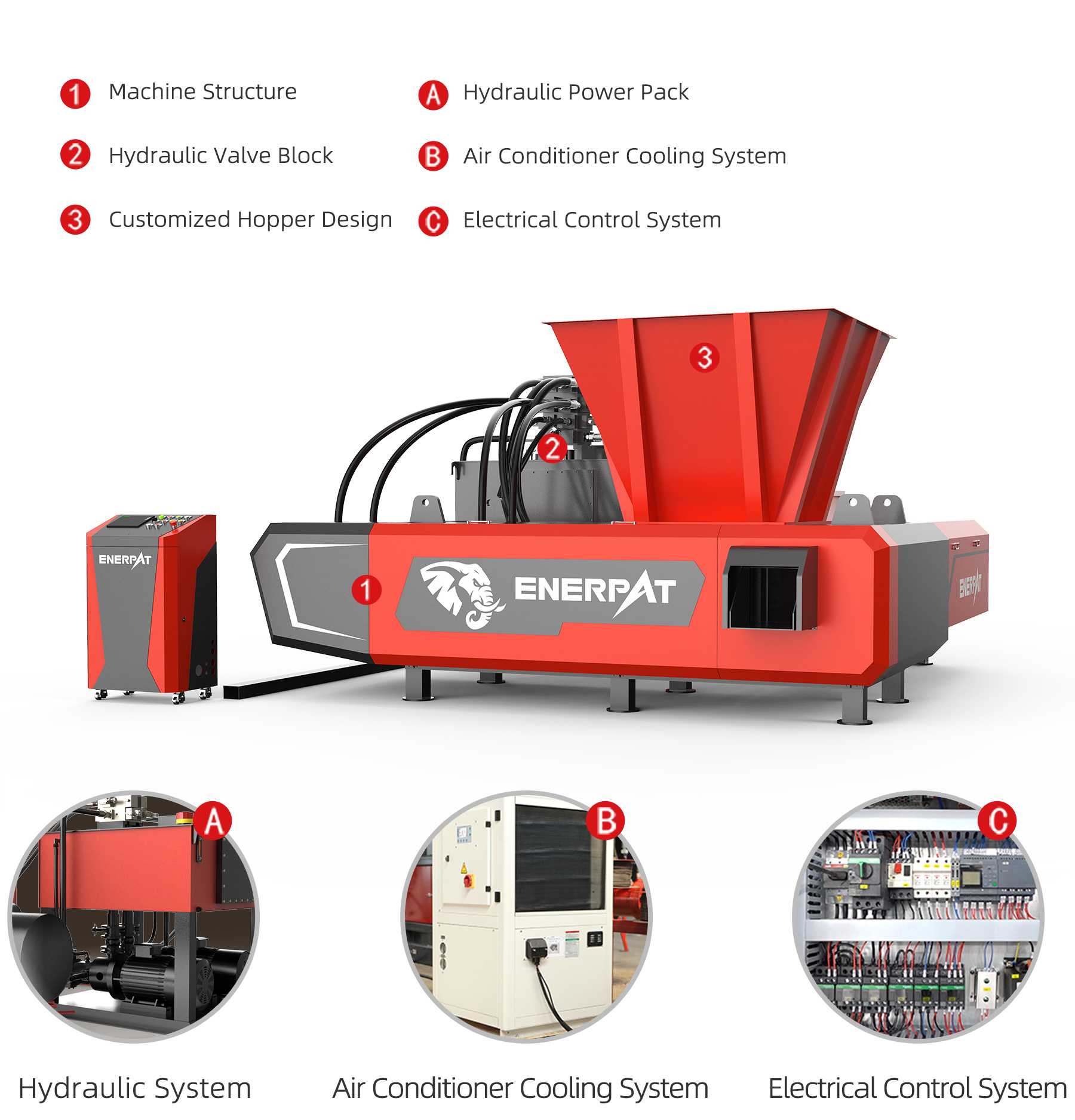
The MSB-E1200 is the front-end size-reduction machine in this project. It belongs to ENERPAT's MSB-E series of low-speed, high-torque industrial shredders, which use two rotating shafts and intermeshing cutters to shear and tear material.
For a business handling rejected power tools, this type of machine provides a way to reduce suitable bulky items before material sorting and recovery.
MSB-E1200 key specifications
Model: MSB-E1200
Machine type: Dual Shaft Shredder / Two Shaft Shredder
Motor power options: 44, 90 or 150 kW
Shredding chamber length: 1,200 mm
Blade diameter: 320–520 mm
Blade thickness: 30 or 40 mm
Shaft speed: 7.5–32 rpm
Machine dimensions: Approximately 3,600 × 2,000 × 2,200 mm
Machine weight: Approximately 6,400 kg
These figures represent the published MSB-E1200 model range. The precise configuration supplied for this project should be verified against the equipment order and technical documentation.
What makes the MSB-E1200 suitable for size reduction?
Low-speed, high-torque cutting action
The two-shaft arrangement is designed to draw material into the cutting chamber and reduce it through shearing and tearing. It is suitable for evaluating applications involving bulky waste, light scrap metals and selected electrical products.
A more manageable material stream
Reducing the size of suitable products before sorting can make subsequent handling more practical. The final output depends on the material's construction, cutter configuration and operating conditions.
Designed for industrial applications
ENERPAT's MSB-E series features an industrial cutting system, a heavy-duty drive arrangement and an electrical control system. These design elements support demanding size-reduction applications, subject to correct machine selection, maintenance and operation.
The actual throughput and output size for rejected power tools must be established through material assessment and, where appropriate, testing. A shredder's nominal capacity should not be treated as a guaranteed production rate for a particular mixture of electrical products.
Equipment 2: ENERPAT AMB-H2014-250 Metal Scrap Baler
After shredding and sorting, suitable metal scrap can be fed into the AMB-H2014-250. This Hopper-Style Automatic Metal Baler is designed for high-density compaction of compatible scrap materials.
Its hopper-based feeding arrangement supports the introduction of prepared material during the operating cycle. The hydraulic system then compresses the scrap into dense, uniform bales for more convenient handling.
For the Melbourne application, the machine provides the downstream compaction stage needed to prepare recoverable metal scrap for storage and transfer.
AMB-H2014-250 key specifications
Model: AMB-H2014-250
Machine type: Hopper-Style Automatic Metal Baler
Main pressing force: 250 tons
Motor power: 99 HP
Press chamber dimensions: Approximately 2,000 × 1,400 mm
Bale cross-section: Approximately 400 × 400 mm
Operating mode: Automatic
Published bale output: Up to 60 bales per hour, depending on material and operating conditions
These specifications are based on ENERPAT's published product information. The maximum bale count is not a guaranteed hourly tonnage for shredded power tools. Actual output and bale weight depend on material composition, bulk density, feed consistency and operating conditions.
How the metal scrap baler supports downstream handling
Compact bales for easier storage
Loose metal scrap can occupy considerable space and be difficult to stack. Compressing suitable material into bales creates a more organised storage format.
More practical material movement
Consolidated bales can simplify internal handling and preparation for collection. The actual logistics benefit depends on bale weight, dimensions, storage arrangements and the requirements of the receiving recycler.
A defined role in the processing line
The baler receives prepared metallic material rather than acting as a substitute for shredding or sorting. This division of work helps establish a clearer process from bulky incoming products to compacted metal scrap.
Automatic operation for repeated processing cycles
The AMB-H2014-250 is designed for automatic compaction. Its suitability for a specific production schedule should be assessed against the material mix, required output and upstream feeding arrangements.
The machine is intended for compatible metal scrap. Mixed shredded electrical waste should not be fed into the baler indiscriminately, as plastics, batteries and electronic components may require separate recovery or disposal routes.
The Practical Benefits of an Integrated Shredding and Baling Process
For this Melbourne project, the value of the equipment combination lies in the workflow it supports. The shredder reduces the size of suitable incoming material; sorting prepares the appropriate metal fraction; and the baler consolidates that fraction for downstream handling.
A more structured approach to rejected-product processing
Instead of treating rejected tools as a loose collection of bulky items, the business can organise them into a defined processing route. This helps separate product rejection, material preparation and scrap recovery into distinct operational stages.
Reduced handling of bulky items
Pre-shredding can make suitable material easier to manage before compaction. It may also help reduce feeding interruptions associated with oversized or irregular items, although the result depends on the material and equipment setup.
Better organisation of recovered metal scrap
Compacting suitable metal fractions can make storage and loading more orderly. This can be particularly relevant to distribution operations where warehouse space is needed for saleable inventory and routine logistics.
Support for downstream recycling arrangements
The customer intended to transfer processed scrap to recycling companies. A defined shredding, sorting and baling sequence can help prepare the relevant material for that handover.
However, the commercial value of the recovered scrap depends on metal type, cleanliness, contamination, market conditions and the buyer's acceptance criteria. Shredding and baling do not, by themselves, guarantee a higher selling price.
Equipment selection based on operational requirements
The project reflects a practical equipment-selection principle: the incoming material and required output should determine the process design. A shredder and a baler have different functions, and matching those functions to the material can be more useful than selecting equipment based on headline capacity alone.
Australia's E-Waste Market: Why Material Recovery Matters
Australia's broader waste-management priorities provide relevant context for businesses handling electrical products. Although this project concerns rejected professional tools rather than the entire e-waste sector, it illustrates a wider operational question: how can products that are no longer suitable for sale be managed responsibly while suitable materials are directed towards recovery?
National e-waste figures highlight the scale of the challenge
According to the Australian Government's Department of Climate Change, Energy, the Environment and Water, Australia generated approximately 511,000 tonnes of e-waste in 2019. The department projected that annual e-waste generation could reach 657,000 tonnes by 2030, an increase of almost 30%.
The same government source estimated that only around one-third of the total material value in Australian e-waste was recovered. Approximately A$430 million in material value was lost to landfill in 2019. These figures cover the national e-waste picture and should not be interpreted as estimates of the professional power-tool market alone. Source: Australian Government e-stewardship information.
For businesses, the figures reinforce the importance of considering material recovery at the point where products leave the sales stream. Better-defined handling and processing arrangements can help direct suitable materials towards appropriate recycling routes.
National policy points towards higher resource recovery
Australia's 2024 National Waste Policy Action Plan includes a target to achieve an 80% average resource-recovery rate across all waste streams by 2030, following the waste hierarchy. It also sets a target to reduce total waste generated per person by 10% by 2030.
The action plan identifies infrastructure, investment, regulatory development and market demand as important elements of the transition towards a circular economy. These are national targets rather than a guarantee of commercial returns for any individual project. Source: Australian Government National Waste Policy Action Plan.
For industrial businesses, this policy direction makes it worth reviewing how rejected products and recoverable scrap are handled. A practical assessment should consider whether existing arrangements provide sufficient control over material separation, storage, collection and recycling.
What businesses should consider before investing
The national outlook does not mean every business needs a complete recycling plant. The right approach depends on the amount and type of material generated, existing collection arrangements and the value of processing it in-house.
Businesses handling rejected electrical products should assess:
Whether products need mechanical size reduction before further processing.
How batteries and other components requiring separate handling will be removed.
Whether metals can be separated from plastics and electronic components.
Whether loose scrap creates storage or loading difficulties.
What material specifications downstream recycling companies require.
Whether the expected volume justifies owning and operating the equipment.
These questions help establish whether a dual shaft shredder, a metal scrap baler or a more comprehensive sorting system is appropriate for the operation.
Is a Dual Shaft Shredder and Metal Scrap Baler Right for Your Operation?
A combined shredding and baling arrangement may be worth evaluating when a business regularly handles bulky rejected products or compatible scrap that needs to be reduced in size before compaction.
A dual shaft shredder for sale is relevant when the incoming material requires size reduction. A metal scrap baler is relevant when the downstream objective is to compact a properly prepared metal fraction for storage and transport.
Before selecting a configuration, review five factors.
Material composition: Identify the metals, plastics, batteries and electronic components present in the incoming products.
Required processing outcome: Define whether the priority is size reduction, product destruction, material separation, compaction or a combination of these requirements.
Actual material volume: Establish daily or weekly quantities and peak loads before estimating the required machine capacity.
Downstream acceptance requirements: Confirm the acceptable material types, contamination limits, bale dimensions and collection arrangements with the receiving recycler.
Installation and operating conditions: Review floor space, electrical supply, material transfer, guarding, dust management, operator training and maintenance access.
These checks provide a sounder basis for equipment selection than relying on a generic capacity figure. They also help determine whether the MSB-E1200 and AMB-H2014-250 combination is suitable for the actual feedstock.
ENERPAT Metal Recycling Machines for Industrial Scrap Processing
The Melbourne installation demonstrates how ENERPAT metal recycling machines can be selected to support two complementary stages of scrap processing.
The MSB-E1200 Dual Shaft Shredder reduces suitable bulky material. After the necessary sorting, the AMB-H2014-250 Metal Scrap Baler compacts compatible metal scrap into dense bales. Together, they provide a defined route from rejected products to prepared material for downstream recycling.
For businesses evaluating a similar investment, the starting point should be the material itself: its composition, size, volume, handling requirements and intended destination. From there, the equipment configuration can be assessed against actual operating conditions.
Contact ENERPAT to discuss your material and recycling requirements. A technical assessment can help establish the appropriate machine configuration, material-preparation steps and downstream handling arrangements before equipment is commissioned.
Equipment specifications and achievable production rates depend on the selected configuration, material characteristics and operating conditions. Project-specific performance should be confirmed through technical assessment and, where appropriate, material testing.
Enerpat is a global company specializing in waste-recycling and disposal solutions, with a mission to help customers build a better, more sustainable world. We are a leading global provider for municipal and industrial clients, helping them recycle and dispose of waste, reduce costs and consumption, and create more value.
We focus on sorters, shredders, balers, shears, and disposal equipment for a wide range of recycling needs. Enerpat believes that “Quality Transform The World.” We deliver the industry’s highest levels of quality and service. Choosing Enerpat means choosing trust and value.
 English